Open Science
Open Science is a global transformation, an inclusive concept that combines various movements and practices aiming to make multilingual scientific knowledge openly available, accessible, and reusable for everyone. It increases scientific collaborations and sharing of information for the benefit of science and society, opening the processes of scientific knowledge creation.
There are four key pillars of open science:
- Open scientific knowledge: Access to publications, data, software, and hardware.
- Open Science infrastructure: Digital and physical resources needed for science.
- Open engagement: Collaboration with societal actors beyond the scientific community.
- Open dialogue: Dialogue with indigenous and traditional systems.
The Association of Swedish Higher Education Institutions (SUHF), in collaboration with the Swedish National Data Service (SND) and the National Library of Sweden, has developed the website openscience.se providing essential information about the key actors, resources, and documents that are central to Sweden’s transition to an open science system.
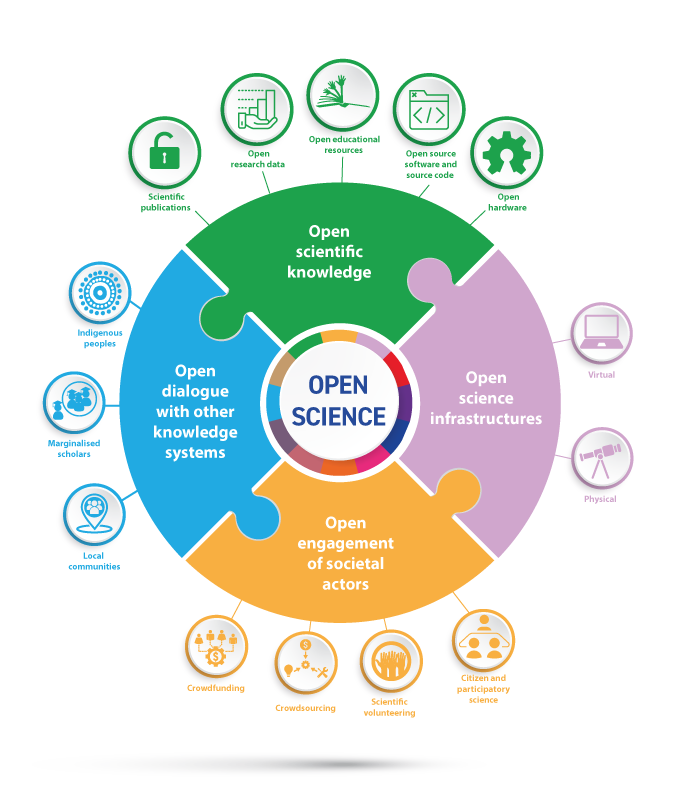
Source: By UNESCO.org - Pillars of Open Science, licensed under CreativeCommons Attribution 4.0 International License CC BY-SA 4.0
Why is Open Science important?
The main motivation for Open Science is that publicly funded research should be accessible to everyone, not just the individual researcher. For transparency and trust reasons, published results and conclusions should be possible to check by others. By making your research outputs available to others, they can address new questions or develop new analytical methods. This will reduce duplication and waste.
How to implement Open Science
Open scientific knowledge is perhaps the area where you as a researcher within Life Science can do most impact:
- For Scientific publications, ensure that you publish in open access journals.
- Publish your data with an open license such as Creative Commons zero or Creative commons Attribution, allowing others to freely do whatever they want when you have answered your own research questions.
- Make your teaching material available in a searchable resource, with an open license, for others to learn or use themselves when teaching.
- Make any source code you create openly available, e.g. by making them downloadable in a public git repository, and get a persistent identifier via Zenodo.
- If you develop hardware, make the design specifications available and add a license so that they can be studied and modified by others.
Adopting the FAIR (Findable, Accessible, Interoperable and Reusable) principles is one of the most efficient ways to reach this broader goal of Open Science. While Open Science is the philosophy of transparency and accessibility, FAIR is the practical toolkit that makes it possible.
Learn more about the FAIR principles
Resources
Please find below resources concerning open science in form of training, guidance and/or tools.
Training resources
- Online course on Open science and data management - KTH
- Open Science - Getting Started - SciLifeLab
- Open Science and FAIR - NBIS
- Rayner, D. (2025). Open Science in the Swedish context - Data reuse. - SND
Guiding resources
- National guidelines for open science - National Library of Sweden
- Openscience.se - SUHF
- Recommendations for FAIR and open research data - Swedish Research Council
Tools
- Open Access Checklist - SciLifeLab
- Open Software Checklist - SciLifeLab